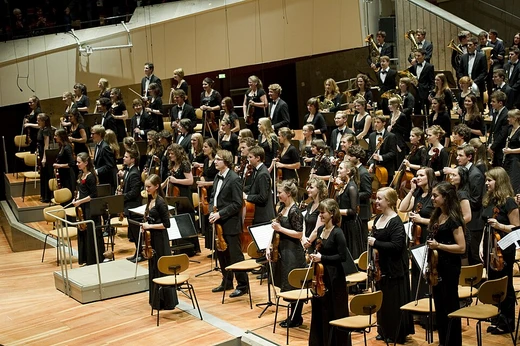
The Rite of Spring
A ballet and concert work that sparked a legendary premiere reaction.

The Rite of Spring (French: Le Sacre du printemps) is a ballet and orchestral concert work by the Russian composer Igor Stravinsky.
- field
- Ballet and orchestral concert work
- nationality
- Russian
Lore & Background
The concept behind The Rite of Spring, developed by Nicholas Roerich from Stravinsky's outline idea, is suggested by its subtitle, 'Pictures of Pagan Russia in Two Parts'. The scenario depicts various primitive rituals celebrating the advent of spring, after which a young girl is chosen as a sacrificial victim and dances herself to death. Stravinsky's score contains many novel features for its time, including experiments in tonality, metre, rhythm, stress and dissonance, and analysts have noted a significant grounding in Russian folk music, a relationship Stravinsky tended to deny.
Reader's Guide
The Rite of Spring is widely considered one of the most influential musical works of the 20th century. Although designed as a stage work, the music achieved equal if not greater recognition as a concert piece. After a mixed critical reception for its original run and a short London tour, the ballet was not performed again until the 1920s, when a version choreographed by Léonide Massine replaced Nijinsky's original, which saw only eight performances. Massine's was the forerunner of many innovative productions directed by the world's leading choreographers, gaining the work worldwide acceptance. In the 1980s, Nijinsky's original choreography, long believed lost, was reconstructed by the Joffrey Ballet in Los Angeles. Regarded as among the first modernist works, the music influenced many of the 20th century's leading composers and is one of the most recorded works in the classical repertoire.
Did You Know?
- The first-night reaction was called a 'riot' or 'near-riot', but this wording did not appear until reviews of later performances in 1924.
- Nijinsky's original choreography saw only eight performances before being replaced in the 1920s by a version choreographed by Léonide Massine.
- The score includes experiments in tonality, metre, rhythm, stress and dissonance, and is grounded in Russian folk music, a relationship Stravinsky tended to deny.
- The ballet's scenario depicts a young girl chosen as a sacrificial victim who dances herself to death.
Frequently Asked Questions
Who composed The Rite of Spring?
The Rite of Spring was written by the Russian composer Igor Stravinsky. It exists both as a ballet score and as a standalone orchestral concert piece.
Who created the choreography and visual design for The Rite of Spring?
Vaslav Nijinsky devised the original choreography, and Nicholas Roerich produced the stage scenery. Together their choices gave the piece its strikingly raw, non-traditional physical and visual language.
More in Classical Music 1-16
Spotted an error? Know more?
This is a living reference — every entry is fact-audited, and reader corrections feed straight into our audit queue. Suggest an edit · See this site's audit record