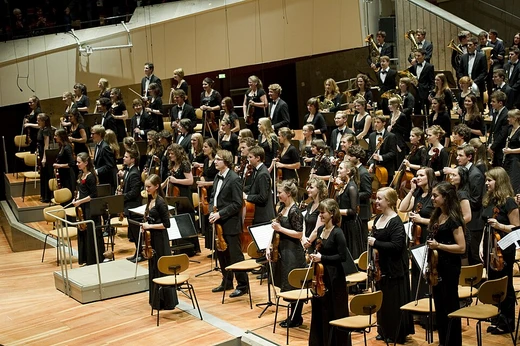
The Marriage of Figaro

The Marriage of Figaro (Italian: Le nozze di Figaro), K. It tells how the servants Figaro and Susanna succeed in getting married, foiling the efforts of their philandering employer Count Almaviva to seduce Susanna and teaching him a lesson in fidelity.
- composer
- Wolfgang Amadeus Mozart
- librettist
- Lorenzo Da Ponte
- premiere_venue
- Burgtheater, Vienna
- genre
- commedia per musica (opera buffa)
- acts
- 4
Lore & Background
Beaumarchais's earlier play The Barber of Seville had already made a successful transition to opera in a version by Paisiello. Beaumarchais's Mariage de Figaro, with its frank treatment of class conflict, was at first banned in Vienna: Emperor Joseph II stated that 'since the piece contains much that is objectionable, I therefore expect that the Censor shall either reject it altogether, or at any rate have such alterations made in it that he shall be responsible for the performance of this play and for the impression it may make', after which the Austrian Censor duly forbade performing the German version of the play. Mozart's librettist Lorenzo Da Ponte managed to get official approval from the emperor for an operatic version, which eventually achieved great success. The opera was the first of three collaborations between Mozart and Da Ponte, followed by Don Giovanni and Così fan tutte. It was Mozart who originally selected Beaumarchais's play and brought it to Da Ponte, who turned it into a libretto in six weeks, rewriting it in poetic Italian and removing all of the original's political references. In particular, Da Ponte replaced Figaro's climactic speech against inherited nobility with an equally angry aria against unfaithful wives. The libretto was approved by the Emperor before any music was written by Mozart. Da Ponte was paid 200 florins.
Reader's Guide
The Marriage of Figaro is considered one of the greatest operas ever written and is a cornerstone of the repertoire. It appears consistently among the top ten in the Operabase list of most frequently performed operas. The overture, in the key of D major with a presto tempo marking, is well known and often played independently as a concert piece. The opera continues the plot of The Barber of Seville several years later and recounts a single 'day of madness' in the palace of Count Almaviva near Seville, Spain. Through the clever manipulations of Susanna and the countess, Figaro and Susanna are finally able to marry.
Did You Know?
- The opera was the first of three collaborations between Mozart and Da Ponte, followed by Don Giovanni and Così fan tutte.
- Da Ponte rewrote the libretto in six weeks, removing all political references and replacing Figaro's climactic speech against inherited nobility with an aria against unfaithful wives.
Censorship and the Politics of Approval
When Beaumarchais's Mariage de Figaro first reached Viennese authorities, it drew immediate suspicion. Emperor Joseph II, while not outright banning the work himself, instructed the official censor to either reject the piece entirely or demand alterations so substantial that the censor would bear personal responsibility for whatever impression the performance left on audiences. The German-language stage version was duly forbidden. Yet the opera's survival hinged on Lorenzo Da Ponte's diplomatic maneuvering. The poet-lyricist secured the emperor's personal sanction for an operatic adaptation, a crucial distinction that allowed the project to proceed. In doing so, Da Ponte also performed a significant act of creative translation: he stripped out the original's pointed political commentary on class hierarchy and inherited privilege. Most notably, he excised Figaro's famous climactic tirade against the nobility and substituted in its place a comparably fiery aria directed at unfaithful wives. The approved libretto was locked in before Mozart set a single note to paper, ensuring the work could move into composition without further bureaucratic risk.
A Single Day of Madness
The opera picks up the story several years after the events of The Barber of Seville, compressing the entire drama into one turbulent day at Count Almaviva's estate, Aguas-Frescas, three leagues outside Seville. The characters have aged and shifted: Rosina has become the countess, while the once-romantic young count has hardened into a scheming, bullying figure who now fixates on exercising his feudal right to claim a servant girl on her wedding night. He has set his sights on Susanna, Figaro's bride-to-be and the countess's own maid, repeatedly stalling the civil ceremony the two servants have arranged for that very day. Dr. Bartolo, still nursing a grudge over Figaro's role in sabotaging his earlier marriage scheme with Rosina, adds another layer of complication by representing Marcellina in a debt dispute that could legally bind Figaro to a woman old enough to be his mother. Against this web of threats, Figaro, Susanna, and the countess forge an alliance, orchestrating a series of deceptions designed to humiliate the count and expose his predatory intentions. Their collective cleverness ultimately prevails, and the two servants are united in marriage.
A Cornerstone of the Opera Repertoire
Few works in the operatic canon enjoy a status as unshakable as Mozart's K. It stands as a foundational pillar of the standard repertoire and consistently ranks among the ten most frequently staged operas worldwide according to the Operabase performance database. Figaro claimed the top position, and the publication characterized it as a towering work of operatic comedy in which a profound sense of humanity pulses through every measure of Mozart's score. The overture alone, a brisk presto movement in D major, has achieved a life of its own as a staple of concert programs, frequently performed independently of the full opera. A complete staging typically runs close to three hours, demanding sustained vocal and orchestral energy from the entire company. The work's instrumentation calls for a full classical wind section alongside the string orchestra, with recitatives traditionally supported by a keyboard instrument and often a cello, the exact accompaniment left to the discretion of the conductor and performers.
The Birth of a Legendary Partnership
The Marriage of Figaro marked the opening chapter of what would become one of the most celebrated creative partnerships in musical history. This was the first of three operatic collaborations between the composer and the poet, the other two being Don Giovanni and Così fan tutte. Da Ponte received 200 florins for his librettistic labor. The completed opera, catalogued as K.
Frequently Asked Questions
What is The Marriage of Figaro's role in the classical repertoire?
It stands as one of the most frequently staged and studied operas in the standard canon, prized for its layered ensemble writing, its sharp social satire, and the way it grants its servant characters the same musical complexity as its nobles.
How does The Marriage of Figaro's story end?
After Figaro and Susanna outwit the Count's schemes to claim his supposed right to seduce Susanna, the couple's wedding proceeds with the full household present. The Count publicly renounces his claim, and the opera closes on the couple's marriage.
Why is The Marriage of Figaro important?
It redefined opera buffa by treating servants and aristocrats as musical equals, a bold social statement for the late 1780s. Its influence on subsequent composers and its near-continuous presence on opera houses worldwide cement its status as a cornerstone of the operatic canon.
More in Classical Music 1-16
Spotted an error? Know more?
This is a living reference — every entry is fact-audited, and reader corrections feed straight into our audit queue. Suggest an edit · See this site's audit record