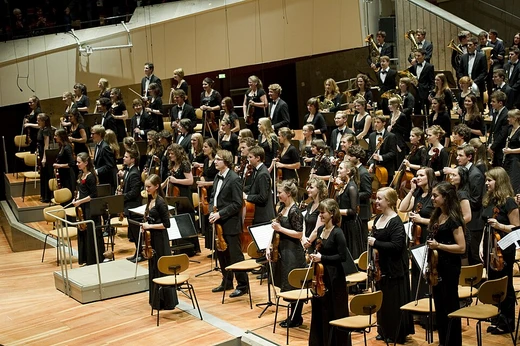
Symphony No. 2 (Mahler)
A large-scale symphony with a choral finale on resurrection.

The Symphony No. It was one of Mahler's most popular and successful works during his lifetime, noted for its large scale and use of a chorus in the finale.
- Composer
- Gustav Mahler
- Key
- C minor (C minor–E♭ major per New Grove Dictionary)
- Duration
- 80 to 90 minutes
- Movements
- 5
- Notable feature
- Uses chorus in final movement
Lore & Background
He wavered for five years on whether to use it as a symphony's opening. The finale proved difficult; Mahler wanted a vocal movement but struggled to find the right text.
Reader's Guide
The symphony is a landmark in Mahler's output, developing the 'sound of the distance' and creating a 'world of its own', aspects already seen in his First Symphony. It was voted the fifth-greatest symphony of all time in a BBC Music Magazine survey of conductors. The work's five movements follow a narrative program that Mahler later withdrew, covering themes of death, remembrance, meaninglessness, and resurrection. Its orchestration includes a large orchestra and a 'Fernorchester' placed outside the concert hall. The first movement is a modified sonata form in C minor, with a five-minute pause requested by Mahler before the second movement, though this is rarely observed. The second movement is a Ländler in A♭ major, the third a scherzo quoting Hans Rott's Symphony No. 1, and the finale uses chorus and soloists.
Did You Know?
- The symphony was voted the fifth-greatest of all time in a BBC Music Magazine survey of conductors.
- Mahler called for a pause of at least five minutes after the first movement, and this is often observed in performances.
The Long Road to Resurrection
Yet he hesitated for five years before committing to a full symphonic structure. He was acutely aware that any choral finale would invite comparison with Beethoven's Ninth, yet he knew he wanted a vocal closing movement.
A Philosophy in Five Movements
Mahler initially crafted a narrative programme for the symphony, showing variant versions to friends including Natalie Bauer-Lechner and Max Marschalk. In this scheme, the first movement depicts a funeral and poses the question of whether life exists beyond death; the second recalls the happy moments of the deceased's life; the third portrays existence as meaningless activity; the fourth expresses a longing for release from that emptiness; and the fifth, after revisiting the doubts and questions of earlier movements, culminates in a fervent hope for transcendent renewal. Mahler would later transfigure this theme into Das Lied von der Erde. As was his custom, he subsequently withdrew all programme versions from circulation, leaving the music to speak without his explanatory scaffolding.
Sound of the Distance
The Resurrection Symphony is a vast work, typically lasting between 80 and 90 minutes, and is conventionally labelled in C minor, though the New Grove Dictionary of Music and Musicians describes its tonality as C minor to E-flat major. Mahler further developed the "sound of the distance" technique and the creation of a self-contained musical world, both already present in his First Symphony. The score calls for a "Fernorchester"—a small additional orchestra positioned outside the concert hall. The first movement, marked with complete gravity and solemnity, employs modified sonata form with a repeated exposition in varied form, a development containing a Dies irae-based theme, and an unusual tonal framework where the secondary theme shifts between E major and C major in unexpected ways. The E-flat major goal is briefly hinted after rehearsal 17 in a trumpet theme that returns in the finale. Following the first movement, Mahler notated a five-minute silence before the second movement—a pause rarely observed by modern conductors. In a BBC Music Magazine survey of conductors, the symphony was voted the fifth-greatest of all time.
Frequently Asked Questions
Why is Mahler's Second Symphony called the Resurrection Symphony?
The nickname comes from the choral text set in the final movement, which deals with themes of death and resurrection. That fifth movement is the only one in the symphony to feature a vocal ensemble.
How long is Mahler's Second Symphony and how many movements does it contain?
The piece is structured in five movements and typically takes between 80 and 90 minutes to perform. Its large-scale architecture made it one of Mahler's most ambitious orchestral works.
What key is Mahler's Symphony No. 2 written in?
The symphony is notated in C minor, though the tonal trajectory across its five movements ultimately resolves toward E♭ major in the finale. This shift from minor to major mirrors the work's broader arc from darkness to transcendence.
Why was Mahler's Second Symphony so popular during his own lifetime?
Late-19th-century audiences responded powerfully to its dramatic scope and the emotional weight of the choral ending. It became one of his most frequently programmed and best-received compositions while he was still alive.
More in Classical Music 1-16
Spotted an error? Know more?
This is a living reference — every entry is fact-audited, and reader corrections feed straight into our audit queue. Suggest an edit · See this site's audit record