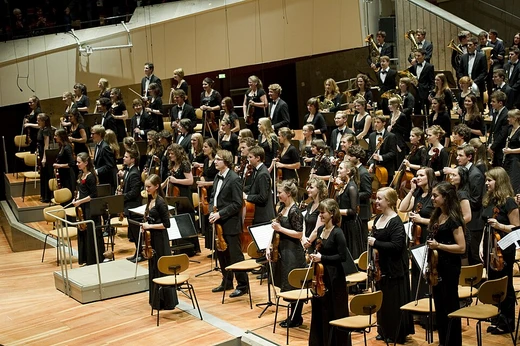
The Magic Flute
Mozart's last opera, a Singspiel with spoken dialogue.

The Magic Flute (German: Die Zauberflöte) is an opera in two acts by Wolfgang Amadeus Mozart to a German libretto by Emanuel Schikaneder. It is a Singspiel, a popular form that included both singing and spoken dialogue. It was Mozart's last opera and was an outstanding success from its first performances, remaining a staple of the opera repertory.
- Composer
- Wolfgang Amadeus Mozart
- Librettist
- Emanuel Schikaneder
- Premiere venue
- Freihaus-Theater auf der Wieden, Vienna
- Genre
- Singspiel
- Language
- German
Lore & Background
Mozart was a close friend of one of the singer-composers of the troupe, tenor Benedikt Schack (the first Tamino), and had contributed to the compositions of the troupe, which were often collaboratively written. Like The Magic Flute, Der Stein der Weisen was a fairy-tale opera and can be considered a kind of precursor; it employed much the same cast in similar roles. Schikaneder's libretto for The Magic Flute is thought by scholars to be based on many sources. Some works of literature that may have served as sources include the medieval romance Yvain by Chrétien de Troyes, the novel Life of Sethos by Jean Terrasson, and the essay "On the mysteries of the Egyptians" by Ignaz von Born. The libretto is also a natural continuation of a series of fairy tale operas produced at the time by Schikaneder's troupe, including an adaptation of Sophie Seyler's Singspiel Oberon as well as Der Stein der Weisen. Especially for the role of Papageno, the libretto draws on the Hanswurst tradition of the Viennese popular theatre. Many scholars also acknowledge an influence of Freemasonry. The Magic Flute appears to have two references to the music of Antonio Salieri. The first is that the Papageno–Papagena duet is similar to the Cucuzze cavatina in Salieri's Prima la musica e poi le parole. Both are centered around musical-textual playfulness with humorous bird-like utterances of pseudo-Italian words. The Magic Flute also echoes Salieri's music in that Papageno's whistle is based on a motif borrowed from Salieri's Concerto for Clavicembalo in B♭ major.
Reader's Guide
The Magic Flute holds a significant place in the operatic repertory as Mozart's final opera, premiering just two months before his death. Its blend of spoken dialogue and sung numbers, characteristic of the Singspiel tradition, helped ensure its immediate and lasting popularity. The work's orchestration is notable for its variety of color, as remarked by Charles Rosen, who noted that each effect—Papageno's whistle, the Queen of the Night's coloratura, the bells, Sarastro's trombones—is a concentrated dramatic stroke. The opera's libretto draws on multiple literary and theatrical sources, including medieval romance, a novel by Jean Terrasson, and the Hanswurst tradition of Viennese popular theatre, with many scholars also acknowledging an influence of Freemasonry. The work also contains musical references to Antonio Salieri, including a similarity between the Papageno–Papagena duet and a cavatina from Salieri's Prima la musica e poi le parole, as well as a motif borrowed from Salieri's Concerto for Clavicembalo in B♭ major. The Magic Flute remains a staple of opera houses worldwide, celebrated for its dramatic and musical richness.
Did You Know?
- The work is scored for two flutes (one doubling on piccolo), two oboes, two clarinets (doubling basset horns), two bassoons, two horns, two trumpets, three trombones (alto, tenor, and bass), timpani and strings.
- Mozart called for a stromento d'acciaio (instrument of steel) to perform Papageno's magic bells; this instrument has since been lost to history, though modern day scholars believe it to be a keyed glockenspiel.
- The Papageno–Papagena duet is similar to the Cucuzze cavatina in Antonio Salieri's Prima la musica e poi le parole.
Composition & Literary Roots
His close friendship with tenor Benedikt Schack, who would create the role of Tamino, deepened his participation in the company's often collaborative compositions. The piece also continued the troupe's string of fairy-tale operas, including an adaptation of Sophie Seyler's Oberon. For the character of Papageno, the libretto specifically tapped the Hanswurst tradition of Viennese popular theatre, and many scholars further identify Freemasonry's influence on the text.
Orchestral Palette & Dramatic Economy
The Magic Flute is scored for two flutes (one doubling piccolo), two oboes, two clarinets (doubling basset horns), two bassoons, two horns, two trumpets, three trombones in alto, tenor, and bass, timpani, and strings, with a four-part chorus entering for several numbers, notably the act finales. Mozart additionally called for a stromento d'acciaio, an "instrument of steel," to produce Papageno's magic bells. That instrument has been lost to history, though modern scholars believe it was a keyed glockenspiel, a role now typically filled by a celesta in performance. Musicologist Charles Rosen observed that the work possesses the greatest variety of orchestral color the eighteenth century produced, yet this very lavishness operates as a paradoxical economy. Each effect is a concentrated, single dramatic stroke: Papageno's whistle, the Queen of the Night's coloratura, the bells, Sarastro's trombones, even the farewell passage for clarinets and pizzicato strings in scene one. No orchestral gesture is merely decorative; each carries a specific dramatic purpose.
Premiere, Playbill & Historical Circumstance
Mozart would die just two months later, making this his final opera. From its very first performances the work was an outstanding success, and it has remained a staple of the operatic repertory ever since. A preserved playbill from the premiere lists the cast, though it provides only abbreviated honorifics—"Hr." for Herr, "Mme." for Madame, "Mlle." for Mademoiselle—rather than full names. Notably, while the opera's female roles are written for different voice types, the playbill referred to all of them simply as "sopranos." The actual casting in the score, however, depends on the genuine vocal range each part demands. The opera's immediate triumph and its enduring place in the repertory stand in poignant contrast to the mere two months that separated its premiere from its composer's death.
Narrative Architecture & the Overture
The opera's narrative centers on Prince Tamino, whom the Queen of the Night persuades to rescue her daughter Pamina from the high priest Sarastro. Instead, Tamino comes to admire Sarastro's community and its high ideals, and he and Pamina undergo severe initiation trials that end in triumph, with the Queen and her followers vanquished. The earthy bird-catcher Papageno, who accompanies Tamino on the quest, fails these trials completely yet is nonetheless rewarded with Papagena as his ideal companion. The overture, composed after the rest of the opera was finished, opens with a solemn three-chord brass sequence associated with the Priests of the Temple of Wisdom. The number three is highly significant in Freemasonry and recurs throughout the work as the number of ladies, boys, and temples. This solemn opening transitions into a lively fugue in E-flat major. Halfway through, a false ending interrupts the music: after another three-chord brass passage, the fugue resumes in E-flat minor before returning to the major key.
Frequently Asked Questions
What makes The Magic Flute different from a typical opera?
It is written as a Singspiel, a popular German form that alternates between sung numbers and spoken dialogue rather than being sung through entirely. This gave the work a more theatrical, accessible feel compared to the fully sung operas that dominated the period.
Who wrote the libretto for The Magic Flute?
Emanuel Schikaneder, an actor, singer, and theatre impresario in late-18th-century Vienna, penned the German libretto. He also ran the theatre where the opera first premiered and was deeply involved in its production.
Why is The Magic Flute considered important in classical music?
As Mozart's last opera, it represents the culmination of his operatic artistry just weeks before his death. Its blend of humor, mystery, and rich musical writing has kept it in continuous performance for over two centuries, making it one of the most frequently staged operas in the world.
More in Classical Music 1-16
Spotted an error? Know more?
This is a living reference — every entry is fact-audited, and reader corrections feed straight into our audit queue. Suggest an edit · See this site's audit record