Symphony
Extended orchestral composition in Western classical music.

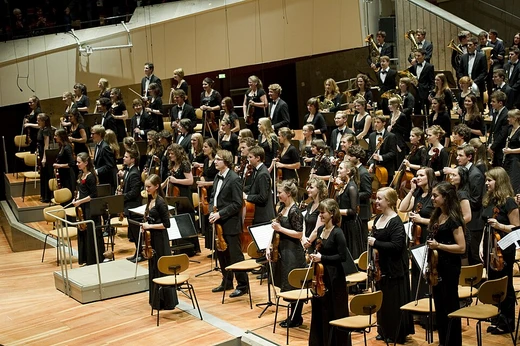
A symphony is an extended musical composition in Western classical music, most often for orchestra. By the late 18th century, the term had taken on its modern meaning: a work typically consisting of multiple distinct sections or movements, often three or four, with the first movement in sonata form. Symphonies are almost always scored for an orchestra of about 30 to 100 musicians, including strings, brass, woodwinds, and percussion, and are notated in a musical score.
- earliest_known_use_of_term
- 16th or 17th century
Lore & Background
The word symphony derives from the Greek συμφωνία (symphōnía), meaning 'agreement or concord of sound.' In late Greek and medieval theory, it referred to consonance, as opposed to dissonance. During the Middle Ages, the Latin form symphonia described various instruments, including a two-headed drum (first noted by Isidore of Seville) and, in French, the organistrum or hurdy-gurdy. By the 16th century, it was equated with the dulcimer, and in German, Symphonie was a generic term for spinets and virginals.
Reader's Guide
In the 17th century, the terms symphony and sinfonia were used for a range of compositions, including instrumental pieces in operas, sonatas, and concertos. The opera sinfonia, or Italian overture, developed a standard structure of three contrasting movements (fast, slow, fast) and is considered the direct forerunner of the orchestral symphony. During the 18th century, the symphony was cultivated with extraordinary intensity, playing roles in church services and aristocratic courts. The four-movement form emerged, typically including a fast opening movement, a slow movement, a minuet or scherzo, and a fast finale. Important early centers included Milan, Vienna, and Mannheim, with key composers such as Giovanni Battista Sammartini, Johann Stamitz, Joseph Haydn, and Wolfgang Amadeus Mozart. At the beginning of the 19th century, Beethoven elevated the symphony to a supreme form in which composers strove to reach the highest potential of music in just a few works.
Did You Know?
- The word symphony derives from the Greek συμφωνία (symphōnía), meaning 'agreement or concord of sound.'
- In the Middle Ages, the Latin form symphonia was used to describe a two-headed drum, as noted by Isidore of Seville.
- The opera sinfonia, or Italian overture, had a standard structure of three contrasting movements: fast, slow, and fast.
- Some symphonies, such as Beethoven's Ninth Symphony and Mahler's Second Symphony, contain vocal parts.
Defining Musical Characteristics
The Classical period, spanning roughly 1750 to 1820, sits between the Baroque and Romantic eras. Its sound is defined by homophony—a clear melodic line floating above a subordinate chordal accompaniment—though counterpoint never fully disappeared, persisting in liturgical vocal writing and later in secular instrumental works. Where Baroque music prized dignified grandeur, the new style galant favored lightness and elegance. Variety and contrast within a single piece grew more pronounced, and orchestras expanded in size, range, and power. The era drew inspiration from Neoclassicism in architecture and literature, seeking the clarity and order of Classical Greek ideals. Newtonian physics reinforced a taste for well-articulated, axiom-based structures, pushing music away from layered polyphony toward a style where chords became more prevalent and tonal structure more audible. Simplicity replaced complexity, and brighter contrasts, dynamic changes, and modulations to more keys gave the music a cleaner timbre.
The Piano Revolution and Instrumental Forms
One of the era's most consequential shifts was the harpsichord's decline as the dominant keyboard instrument, replaced by the piano or fortepiano. The harpsichord plucked strings with quills, meaning the force of a key press had no effect on volume or timbre. The piano, by contrast, strikes strings with leather-covered hammers, allowing the performer to play louder or softer—hence the name fortepiano, literally loud soft. This mechanical difference unlocked a new level of expressiveness. Instrumental music became central to the period's output, with the sonata, trio, string quartet, quintet, symphony, and solo concerto forming the main genres. The solo concerto, in particular, showcased a virtuoso performer on violin, piano, flute, or another instrument against an orchestral backdrop. Vocal music also flourished, encompassing art songs for singer and piano, choral works, and staged opera for singers and orchestra.
The Viennese Classicism Circle
The era is often called the period of Viennese Classicism, a label rooted in the remarkable concentration of composers who worked in Vienna. The roster reads like a who's-who of Western music: Christoph Willibald Gluck, Georg Christoph Wagenseil, Georg Matthias Monn, Joseph Haydn, Johann Georg Albrechtsberger, Carl Ditters von Dittersdorf, Johann Baptist Wanhal, Antonio Salieri, Wolfgang Amadeus Mozart, Ludwig van Beethoven, and Franz Schubert. This geographic clustering created a shared aesthetic vocabulary while each composer brought distinct contributions. The period's instrumental forms—the symphony performed by orchestra, the string quartet, the concerto—grew in sophistication partly because of the competitive and collaborative environment such a concentration fostered. The era also saw a shift in who commissioned and attended music: the nobility became primary patrons of instrumental works, while public taste gravitated toward lighter, comic operas. This dual audience shaped the repertoire, pushing composers to balance aristocratic refinement with popular appeal.
Structural and Social Transformation
The Classical period's musical changes were inseparable from broader economic and social shifts. As the century progressed, the nobility assumed the role of primary patrons for instrumental music, while public audiences increasingly favored lighter, comic operas. This altered performance practices: standard instrumental groups replaced the flexible Baroque continuo ensemble, and the term obbligato—a mandatory added part in chamber music—became redundant as all parts were specifically indicated. By 1800, basso continuo was practically extinct outside the occasional pipe organ part in a religious Mass. Smaller, fixed-size court ensembles also spurred composers to write simpler ensemble parts alongside spectacular idiomatic passages for virtuoso soloists, as seen with the Mannheim orchestra. Audiences demanded a continual supply of new music, and works had to be performable with one or two rehearsals at most. Greater emphasis on a single melodic line also meant composers increasingly notated dynamics, phrasing, and ornaments like trills and turns, rather than leaving those details to performer improvisation as in the Baroque.
Frequently Asked Questions
What is a Symphony?
A symphony is a large-scale orchestral work in the Western classical tradition, typically built from several contrasting movements. It is generally regarded as the most ambitious and extended form in the standard orchestral repertoire.
How is a Symphony structured?
Most symphonies consist of three or four separate movements, with the opening movement written in sonata form. The later movements shift to different tempos and moods, creating an emotional arc across the whole piece.
What instruments play in a Symphony?
A symphony is scored for a full orchestra of roughly 30 to 100 players, covering strings, woodwinds, brass, and percussion. All parts are written out in a shared musical score that each section reads from during performance.
When did the Symphony take its modern shape?
The word itself dates back to the 16th or 17th century, but the form we recognize today—multi-movement, sonata-based, fully orchestral—settled in the late 18th century. That corresponds to the era of Haydn and the early Classical period.
Why is the Symphony considered so important?
It sits at the top of the orchestral hierarchy because it demands the largest forces and the most sustained compositional architecture of any standard form. For listeners and performers alike, it represents the peak of what a full orchestra can achieve in a single work.
More in Classical Music 1-16
Spotted an error? Know more?
This is a living reference — every entry is fact-audited, and reader corrections feed straight into our audit queue. Suggest an edit · See this site's audit record