Frequently Asked Questions
The most-asked questions about classical music.
What counts as 'classical music'?
Classical music generally refers to the Western art-music tradition stretching from the medieval period through the 20th century and beyond. It encompasses symphonies, operas, concertos, chamber works, and sacred compositions written primarily for trained performers and concert-hall audiences. In everyday usage, people often narrow the term to the roughly 1750–1900 Classical and Romantic eras.
Who are the three composers most associated with the genre?
Bach, Mozart, and Beethoven are the figures most frequently cited as pillars of the repertoire. Bach (1685–1750) established much of the harmonic and contrapuntal language, Mozart (1756–1791) perfected the Classical style, and Beethoven (1770–1827) broke that mold open into the Romantic era.
Where should a complete beginner start listening?
A good entry point is a short, emotionally direct work such as Vivaldi's 'The Four Seasons,' Beethoven's Fifth Symphony, or Debussy's 'Clair de lune.' Listening to a few minutes at a time and letting the music speak before studying theory keeps the experience welcoming.
What's the difference between a symphony, a concerto, and a sonata?
A symphony is a multi-movement work for full orchestra, a concerto features a solo instrument in dialogue with the orchestra, and a sonata is typically written for one or two instruments without orchestral accompaniment. All three usually follow a multi-movement structure, but the performing forces and spotlight differ.
What are the main historical periods of classical music?
The broad periods are Baroque (c. 1600–1750), Classical (c. 1750–1820), Romantic (c. 1820–1900), and 20th/21st-century (1900–present). Each era introduced new instruments, harmonic languages, and aesthetic goals that still shape the works performed today.
What is the most-recognized piece in the repertoire?
Beethoven's Symphony No. 5 is often cited as the single most recognizable work, largely because of its four-note opening motif. Mozart's 'Eine kleine Nachtmusik' and Vivaldi's 'Summer' from The Four Seasons also consistently top streaming and performance surveys.
What instruments make up a standard symphony orchestra?
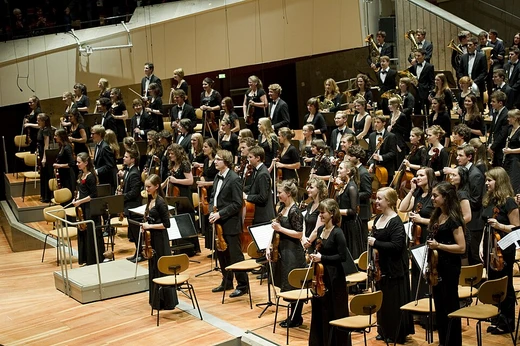
A typical orchestra is divided into four families: strings (violins, violas, cellos, double basses), woodwinds (flutes, oboes, clarinets, bassoons), brass (horns, trumpets, trombones, tuba), and percussion (timpani, snare, cymbals, and others). A full ensemble usually numbers around 80 to 100 players.
What does a conductor actually do during a performance?
A conductor interprets the score, sets tempo and dynamics, balances sections, and cues entrances so that dozens or hundreds of musicians play as a cohesive whole. The role is less about 'playing' the music and more about shaping its architecture in real time.
Is classical music only for the elite or for older audiences?
No—classical music is a global, living tradition with active composers, performers, and audiences of every age. Streaming platforms, community orchestras, and crossover projects such as film scores and video-game soundtracks continue to bring new listeners into the fold.
What are some landmark 'firsts' in classical music history?
Peri's opera 'Dafne' (c. 1597) is often credited with launching the operatic tradition, and Beethoven's 1808 'Eroica' premiere in Vienna marked a turning point where a single composer's personal voice overrode courtly convention. Stravinsky's 1913 'Rite of Spring' premiere, which sparked a near-riot in Paris, became a cultural milestone for 20th-century music.